
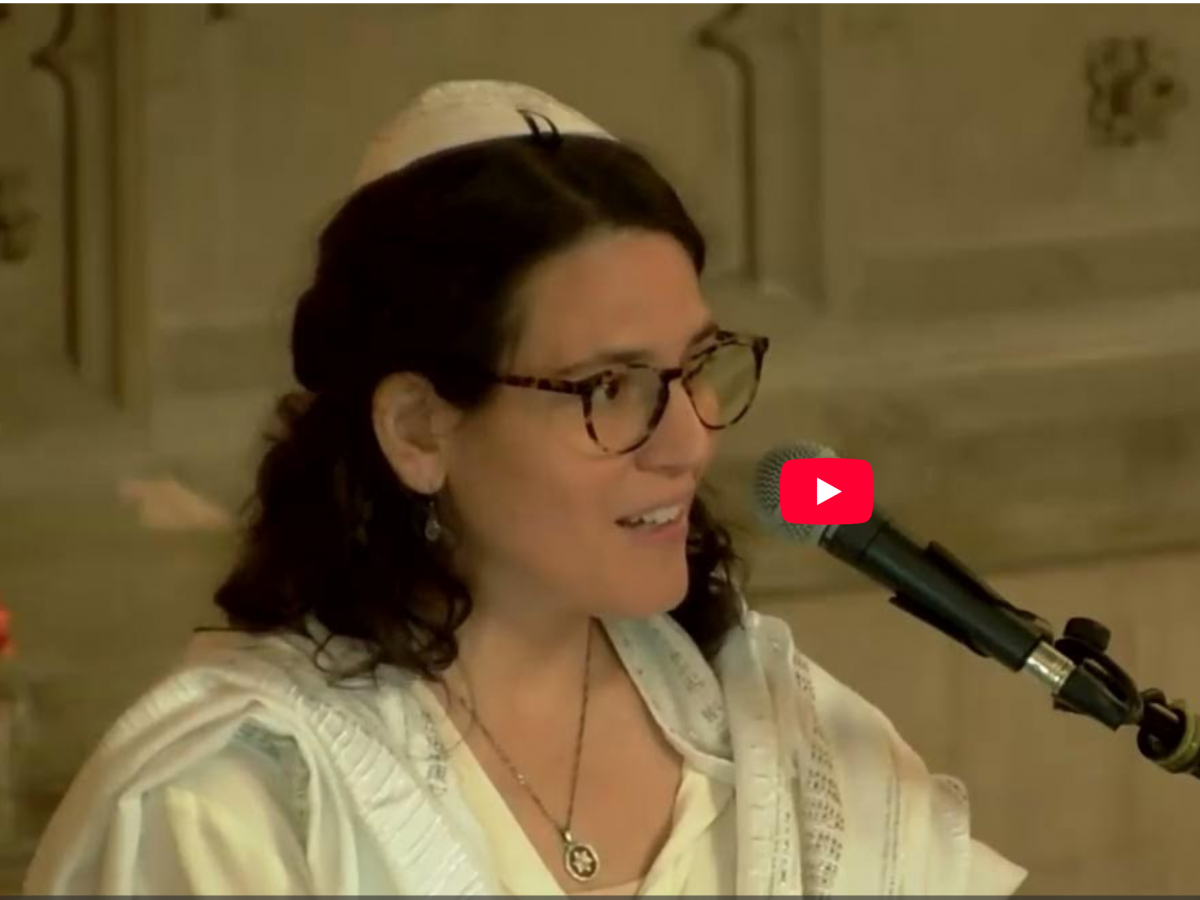
[To view as video, please see here.]
Ten years ago, I moved to Jerusalem. There’s a lot that I could say about that time, but today I’m thinking about a particular moment: the night of November 8th, 2016. You may recall that here in the United States, there was a rather important election happening. So I got up to a 3AM alarm and walked through the quiet Jerusalem streets to the campus of Hebrew Union College, where students from several progressive rabbinical schools gathered to watch the results roll in. We had pizza, beer, and hope.
Over the course of the night, the pizza got cold, the beers went flat, and our hope turned to horror. Early in the morning, we walked into the courtyard, the autumn sunrise bringing a discordant glow to the limestone, and davenned a subdued Shacharit. I skipped Talmud class— we were studying Avodah Zarah, the tractate about relations between Jews and non-Jews, and the last thing I felt up to doing was reading about why diversity was dangerous and bad. Instead, I started to write words that a decade later I still hold as true: “What do we do when it seems hopeless? We remember that our hearts can be safe in their shells but they will never be able to grow there. A heart can only grow if it is free, and anything that is free can be broken, and so we must place our hearts into one another’s care to risk and to thrive.”
For Jews today, this is a tall order.
Last night, I spoke about antisemitism, anti-Zionism, and the challenge of being a Jew in such a devastating time. This morning, I want to talk about how we combat antisemitism in a way that will lead our people not just to survival but to life.
When we speak of the Holocaust, we rightfully lift up the memories of the 6 million Jews murdered by the Nazi regime. Jews were the center of Hitler’s cruelty, the scapegoats upon whom his entire political platform rested. But they were not alone. Sinti and Roma people, LGBTQ people, disabled people, Catholics, Jehovah’s Witnesses, Black and mixed-race people, Soviet prisoners of war, and Communists were all prosecuted and murdered alongside us.1 According to the United States Holocaust Memorial Museum, the Nazis killed somewhere around 6 million non-Jewish victims.
Devastating as this is, it shouldn’t be surprising, because where hatred of one minority group exists, hatred of others accompanies it. In 2017, when white nationalists took to the streets of Charlottesville, at first what many people thought they heard them chanting was “You will not replace us.” But that wasn’t it. It was “Jews will not replace us.” Jews. A group comprising less than 3% of the American population, but a group associated by the far right and the far left with a network of conspiracy theories that somehow catapult us from a tiny minority with little overall power to a puppet-string-holding cabal manipulating figurehead leaders. As Shane Burley and Ben Lorber wrote in their book, Safety through Solidarity: A Radical Guide to Fighting Antisemitism, “While many oppressions claim to ‘punch down’ antisemitism claims that by ‘punching up’ at all-powerful Jews, society can become more holy, more pure.”2
Antisemitism cannot be uncoupled from racism, so here is where we need to talk about Judaism and whiteness. To do that, we need to start with three truths:
- Not all Jews are white. There have always been Jews of Color. Some come from communities around the world comprised of non-white people, others from multiracial families that have become Jewish families over time. Others still have converted, or are BIPOC adoptees into white Jewish families. A “Jews of Color Initiative” Survey in 2024 found that 12-15% of American Jews are not white.3 And Ashkenazi Jews, the group most likely to be classified as white, are a minority in Israel today.
- Jews who look like me are white. But that wasn’t always so, and our whiteness is liminal. The liminality of our whiteness does not make it any less real when it operates as whiteness.
- White Jews are often the descendants of Jews who assimilated into whiteness because doing so afforded opportunities that remaining outside of whiteness would not. In becoming white, like other European minority groups before them, white Jews gained access to better housing, careers, education, and social status. They had the chance to acquire generational wealth that many of us benefit from today. Black and brown Americans were not often given the same opportunities. And, even as white Jews benefited from racial status, they continued to suffer from antisemitism.
These three truths lead to a complicated reality wherein white Jews in our racist, Christian hegemonic society are simultaneously privileged and underprivileged. As Burley and Lorber wrote: “The story of Jewish whiteness is a story of persecution on one side, and complicity in persecution on the other. It illustrates how Jews, like any group, can hold both oppressed and oppressor roles, often simultaneous and overlapping, within a social order.”4
White Nationalists place Jews at the center of the Great Replacement Theory, which, in the words of historian Jonathan Sarna, “is expressing centuries-old fears that Jews, in league with peoples of color, are engaged in a nefarious plot to destroy the white Christian civilization.”5
Derek Black echoes this. They grew up as David Duke’s godchild before renouncing white nationalism in college after their Jewish classmates gradually helped them to see a different perspective. They wrote: “White nationalists believe that all of their problems with society are created by an organized conspiracy of Jewish people who are motivating and pushing immigration laws, civil rights laws. And it’s a belief system that in many ways disregards people of color so that it’s not possible that that organizing is coming from actual racial justice organizations, but that it is a secret cabal, a conspiracy by Jewish people and therefore Jewish people are the main targets of white nationalists.”6
White nationalists, in other words, hold Jews at the center of their hate because they do not place enough stock in BIPOC Americans’ abilities. When the Charlottesville protesters were shouting “Jews will not replace us,” they meant that they wanted to stop Jews from bringing about a multiracial, justice-oriented society. When the Pittsburgh shooter attacked Tree of Life Synagogue, he wrote “HIAS likes to bring invaders in that kill our people,” blaming a Jewish refugee-focused organization for the presence of immigrants across the United States.
So all of this is connected, but not because the Jews are the masterminds of it. The question is, what do we do about it?
There are two main approaches to combating antisemitism. One is Safety through Siloing. The other is Safety through Solidarity.
Safety through Siloing we know well. None of you entered this sanctuary without a security check, and none of you got on Zoom without registering. Safety through Siloing leads to rallies against antisemitism that don’t acknowledge other forms of oppression, to public letters accusing politicians of ignoring Jews (and only Jews), to drawing lines in the sand that divide us from other minority groups and– often— rightwing and centrist Jews from leftwing Jews. Still, there are times when Safety through Siloing is an important tactic, and given the long history of Jews being turned on by their fellow countrymen, it is understandable to turn to Safety through Siloing as a first line of response. However, I do not believe that it will get us where we need to go.
On June 12, 1945, just over a month after the Nazis surrendered, a group of over 200 Orthodox rabbis gathered in midtown Manhattan and voted to place Rabbi Mordecai Kaplan into cherem– spiritual excommunication. They burned his newly published Reconstructionist prayer book, desecrating the name of God, an act made all the more extraordinary given its chronological proximity to Nazi book burning. There are many liturgical shifts in Reconstructionist siddurim, from the removal of references to the resurrection of the dead to the toning down of offensive language in Aleinu. But the most famous of Kaplan’s liturgical changes was chosenness and his assertion that we Jews are not the chosen people.
Judaism has always been caught up with the question of particularism vs. universalism. How much are we our own community, and how much are we a part of a greater community? Part of what draws me to Reconstructionist Judaism is Kaplan’s belief that Jews are not meant to live their lives apart, that we are best served by honoring our connection to both of our civilizations— one religious, one secular. He wrote, in a reflection on a Yom Kippur sermon in 1955, that one of religion’s primary functions is to inculcate “faith in society as capable of evolving a method of social interaction based on truth, reason, freedom, justice and peace, which method is essential if society is to enable those who belong to it to achieve salvation.” Meaning, we have to have some amount of trust and investment in the larger world we’re a part of, even when it isn’t living up to the expectations we have for it.
At its most basic, Safety through Solidarity is operating with an understanding of that larger world. That antisemitism is not an isolated hatred but rather part of a system of prejudices including racism, homophobia and transphobia, Islamophobia, sexism, ableism, and the list goes on. This system, which benefits white, straight, cisgender, Christian men, harms everyone else to varying degrees, and therefore it is to the benefit of those with the most power to turn groups with less of it against one another.
Jews have suffered from this tactic throughout history. When, in the middle ages, feudal lords caused crushing debt, Jews were often intermediaries between the rulers and the farmers, making them the targets for rage that morphed into pogroms.7 Centuries later, when MLK was assassinated, the alliance between Black Americans and Jews for civil rights began to fray because Jews started to be viewed as “too white” to be true allies.8 Today, we see some multifaith and multiracial campus coalitions excluding Jewish groups that do not identify as anti-Zionist because students make sweeping assumptions about Jewish students’ politics and morals. We have also seen this with other groups. In British colonial America, Black and white indentured servants initially banded together. Then, the ruling class started making legal distinctions, placing lower class white people “above” Black people so that they would no longer ally together against the elites. Today, many politicians are trying to divide the LGBTQ community, pitting relatively privileged cis Gay men against far more oppressed trans and non-binary people, particularly people of color.
This is par for the course for the political Right, although the Left is not immune to it. As Burley and Lorber write: “Unlike the Right– where antisemitism, whether in explicit or coded form, is central to the ideology of reaction and exclusion– antisemitism on the Left is ultimately something that, when confronted, can be undone with commitment and perseverance, since it runs in the face of the Left’s core values of equality and justice.”9
That confrontation is not easy. Particularly since October 7th, more and more leftwing spaces are stating “No Zionism” in the same way that they would “No Racism.” As in, you can be Jewish, but if, like the vast majority of Jews, you say you support Israel— whatever that may mean to you— your welcome could be rescinded. And things on the Left may very well get worse before they get better, in great part because of just how normalized antisemitism unrelated to Israel is becoming in mainstream Rightwing discourse, bleeding out from there into all sectors of society.
Rightwing Zionism is another matter. Rightwing Jewish leaders in the United States and in Israel increasingly embrace Christian philosemites— people like Reverend John Hagee who are strong supporters of Israel not because they genuinely care for Jews but because of what Israel represents in Christian theology. According to the Book of Revelation, Jews must possess Israel before Jesus Christ’s return, which will trigger Armageddon and result in Christians being raptured while non-Christians die gruesome deaths. And so Evangelical support for Zionism isn’t about support for Jews at all. Yet, CUFI, Christians United for Israel, counts nearly three times more members on its roster than there are total Jews in the United States, and is embraced by many Jewish organizations. Republican politicians are also using support for Israel as a stand in for support of American Jews across the political spectrum, even when doing so means labeling antisemitic Zionists friends to Jews, while labeling anti-Zionist and liberal Zionist Jews antisemites.
And so progressive Jews are caught in a strange and uncomfortable place, with some organizations we’ve supported for years seeming to abide antisemitism while organizations and politicians we may not normally be drawn to are speaking about prioritizing Jewish safety more than about any other minority group’s needs.
I have never nor will I ever tell you who to vote for (although when elections are coming up I will remind you, often, to vote). In times like these, it is understandable that some of you may want to vote for candidates who speak to Jews most directly— who promise to put more funding into combatting antisemitism, who pledge to continue military support for Israel, who advocate for shutting down campus organizations that use “Zionist” as a slur. Some of you may feel that, in times like these, survival for our people must come before we can begin to think about the needs of any other people. As I’ve said many times, we Jews carry trauma, and we are primed to be ready for trouble.
But we aren’t the only ones. We share this society with other peoples whose safety is on the line. According to the ACLU, in 2026 alone, 40 anti-LGBTQ laws and especially anti-trans laws have been enacted around the country, and 58 more are advancing in their respective state legislatures.10 Black people, who make up 13% of the American population, are 38% of the population in prisons, with nearly 3% of Black men in America incarcerated at any given time.11 Every day, undocumented and in some cases documented immigrants are being deported, and young children have been forced to appear without legal representation in court. And American Muslims, particularly under the Trump administration, are subject to discrimination and hate just like us.
Rabbi Sharon Kleinbaum, rabbi emerita of CBST, and Dr. Debbie Almontaser, a Muslim educator and activist, recently wrote an Op-Ed about the threat that Jews, Muslims, and other minority groups face, reminding us that: “White supremacy does not distinguish between the communities it seeks to intimidate. Our resistance shouldn’t distinguish between them, either….The future of our communities won’t be secured by louder accusations. It will be secured by deeper relationships. The antidote to hate has never been silence — it has always been solidarity. If we defend one another with the same urgency we defend ourselves, we will not only make our synagogues and mosques safer. We will strengthen the promise of America itself. ”
Professor James Loeffler explained it this way: “The civil rights revolution was never finished. Now its contradictions have returned, sharper than ever. They won’t end with antisemitism, because debates about Jews are never just about Jews. They are the seismographs of a society’s deeper tremors: its fears of difference, its contested visions of nationhood.”
Safety in Solidarity is our path to the nation I believe Reconstructionism urges us to seek: one that prioritizes equality and opportunity, one that evolves as the people in it evolve, and one that pushes us to risk in ways that might seem outlandish when first starting out but that, a decade or two later, most others follow.
The theme of our High Holy Days this year, “P’tach Libeinu, Open Our Hearts”, comes from Talmud. In Berakhot 17a, here’s a discussion of how various rabbis concluded their prayers. Rav Safra prayed for peace and for scholars to study Torah for its own sake. Rabbi Alexandri prayed for deliverance from evil. Rava prayed for a reasonably tolerable cleansing of sin. And Mar Ravina began the conclusion to his prayers with words that might be familiar to some of us:
אֱלֹהַי, נְצוֹר לְשׁוֹנִי מֵרָע וְשִׂפְתוֹתַי מִדַּבֵּר מִרְמָה
“Dear God, protect my tongue from evil, and my lips from telling lies.” He continues:
וְלִמְקַלְּלַי נַפְשִׁי תִדּוֹם, וְנַפְשִׁי כֶּעָפָר לַכֹּל תִּהְיֶה. פְּתַח לִבִּי בְּתוֹרָתֶךָ,וּבְמִצְוֹתֶיךָ תִּרְדּוֹף נַפְשִׁי
“To those who curse me, let my soul be silent and may my soul be like dust to all. Open my heart to Your Torah, and may my soul pursue your mitzvot.”
These words, once just an individual sage’s supplication, have been codified as the start of the meditative conclusion to our Amidah. But what does it mean to truly open our hearts to Torah? What does it mean to truly open our hearts to anything?
I was moved this year by Rabbi Avi Kilip’s interpretation of this passage for Hadar. He wrote:
“I read this phrase in two ways: ‘Open my heart to your Torah,’ and also, ‘Open my heart with your Torah.’ Open my heart to your Torah: Keeping an open heart to Torah has been harder recently for many Jews. The particular pressures of the world—the painfully tragic wars in Israel and the hatred of Judaism that increasingly surrounds us—make it feel like it might just be easier to close ourselves to religion, to Torah, to Judaism altogether. We feel our hearts close. We may need this reminder right now to keep our hearts open to Torah. Open my heart with your Torah: Torah is what opens and expands my heart. Torah reminds me that I am part of a larger story, that there is a difference between right and wrong, that this difference matters, that God made this world, that holiness is real. I must continue to open my heart to Torah, so that Torah can continue to open my heart. We should not live our lives with permanently closed hearts.”
Last night I spoke about my grandfather, who told me that he thought Judaism would always exist because of antisemitism. His middle name was his mothers’s maiden name Cheim— C-H-E-I-M— an obviously anglicized pronunciation of Chaim. Chaim, of course, means life. I loved my grandfather fiercely, and when I took a Hebrew middle name for myself several years ago (my parents just gave me a first name when I was a child), I chose Chaya in honor of his mother Helen Cheim, my own English middle name sake. I wanted to lift up in my name the hope of life, despite all odds. Not just survival. Life. Engagement with our world, with an openheartedness that brings risk but also meaning. And the truth is, although my Grandpa Mort told me he thought it was antisemitism that would ensure a Jewish future, what I inherited from him was an open-hearted Judaism: one that brought him joy and connection, and that privileged learning and growth.
That’s the kind of Jew I want to be and that I want to raise my son to be. If our well-being can only come through the degradation of and destruction of other peoples, that’s not something I can get behind. I don’t believe that that would even be worth fighting for. But if our well-being can come from collective building of a shared future, even if it’s a lot of painful work to get there—and it surely will be— I’m ready. I hope you are too. And if you’re not, I’m here for you anyway, always. May we each be inscribed for vibrant life this year. G’mar chatimah tovah.
1 https://www.yadvashem.org/holocaust/about/nazi-germany-1933-39/non-jewish-victims.html
2 Burley & Lorber, 22
3 https://thejoci.org/research/counting-inconsistencies-study/
4 Burley & Lorber, 268
5 https://www.brandeis.edu/jewish-experience/jewish-america/2021/november/replacement-antisemitism-sarna.html
6 https://www.pbs.org/wnet/exploring-hate/2021/10/29/roots-antisemitism-white-supreamcy/
7 Burley & Lorber, 97
8 Nadell, 215
9 Burley & Lorber, 309
10 https://www.aclu.org/legislative-attacks-on-lgbtq-rights-2026?impact=


